.png)
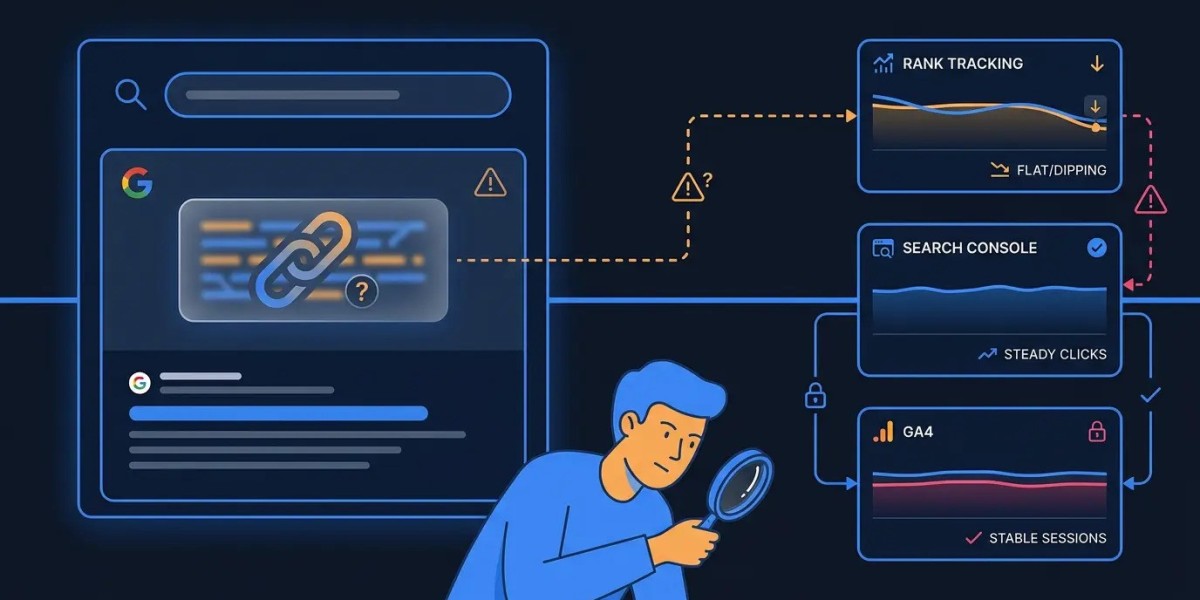

There is a particular kind of modern internet frustration that arrives wearing a pleasant, sensible face.
You search for a restaurant, a doctor, a city permit, a product manual, an article, a company’s customer-service number, a public filing—anything that ought to exist plainly and independently on the web. Google presents a result. You click it. Your browser begins a brief, nearly invisible journey through Google’s own infrastructure before it deposits you at the page you wanted.
Most users never notice. That is the point.
The address bar flickers. A URL expands, collapses, and gives way to another. There may be a fragment of code, a tracking parameter, a redirect endpoint, an opaque string that looks less like a web address than a shipping label. The click feels direct because it is designed to feel direct. But it is not always direct. It is mediated, observed, translated, and, in ways that remain difficult for ordinary users to audit, made legible to the company standing between the searcher and the rest of the internet.
Google’s use of redirect mechanisms—often discussed under the broad umbrella of “GoTo” or click-tracking redirects—is not merely a technical footnote. It is part of a larger story about who gets to see the web clearly, who gets to measure how people move through it, and who gets to define what a “search result” even is.
For a company that built its empire on organizing the world’s information, the more consequential ambition may be organizing the routes by which people reach it.
The Click Is Not a Simple Thing
In the sentimental version of the early web, a hyperlink was a handshake. One page pointed to another. A blue underlined phrase said, in effect: Here. Go look for yourself.
The link was not neutral, exactly—editors, publishers, webmasters, and advertisers all had motives—but it was transparent. Hover over the text and you could see the destination. Click it and your browser went there. The path belonged, at least in principle, to you.
Search changed that. Google made the web navigable at planetary scale, converting an anarchic wilderness of pages into a useful index. In doing so, it became the world’s most important traffic cop. A publisher could write the definitive guide to a subject, but if Google did not surface it, most people might never know it existed. An online retailer could have a beautifully designed storefront, but a small shift in ranking could turn a brisk business into a quiet one. A local service provider’s phone might never ring if it failed to appear in the “map pack,” the tightly controlled real estate near the top of a search-results page.
The power was initially easy to understand: Google decided which answers appeared first.
Today, the system is more complicated. Google does not simply hand you links. It creates an environment around the links: featured snippets, knowledge panels, image blocks, map results, shopping units, AI-generated summaries, related questions, video carousels, ads designed to resemble organic results, and increasingly elaborate ways of keeping users inside Google’s own frame.
Click redirects belong to the architecture of that frame.
A redirect is, in the most basic technical sense, a relay. Instead of sending a browser from Page A directly to Page B, the browser first visits an intermediary address. That intermediary can record information, enforce security rules, add or remove parameters, check whether a destination is acceptable, attribute an ad conversion, or simply hand off the user to the final URL. Redirects are not inherently sinister. They are a normal part of how the web works.
Banks use them. Authentication systems use them. E-commerce platforms use them. Email providers use them to protect users against malicious links. Marketing software uses them to measure whether a campaign produced a click. A modern browser would be a less safe and, in some cases, less functional place without them.
But scale changes meaning.
When the intermediary is Google—the dominant search gateway for much of the internet—the redirect becomes more than a routing detail. It becomes another thread in an already vast behavioral tapestry: what people searched for, what results they were shown, what they clicked, what they ignored, whether they returned, whether they refined their query, and perhaps which result ultimately seemed to satisfy them.
Google does not need every technical maneuver to be nefarious for the cumulative effect to be unsettling. It only needs to make itself the indispensable witness to the click.
A Web Seen Through Tinted Glass
The company’s defenders would say this is how search gets better. And, to be fair, there is truth in that.
Search engines need signals. If ten million people search for “how to fix a leaking faucet,” click a result, spend 20 seconds on the page, immediately return, and choose another result, that tells the search engine something. If users click a particular guide and stop searching, bookmark the page, or follow related links, that may indicate that the result was useful. Ranking systems built without any feedback from real behavior would be prone to manipulation, blind to changing language, and hopelessly detached from what people actually find helpful.
This is the clean technocratic argument: measurement improves relevance.
But users are not merely sources of relevance data. They are also citizens of an increasingly enclosed information economy. And the same systems that allow Google to learn whether a result pleased a user can allow Google to deepen its understanding of the user, tighten its grip on publisher traffic, and make the mechanics of discovery more opaque.
The relevant question is not whether Google should be allowed to collect any information about clicks. It is whether a company with Google’s position should be allowed to make the journey from query to destination so dependent on its own machinery that independent measurement becomes harder, user choice becomes less visible, and the supposedly open web starts to resemble a series of exits inside a privately owned airport.
The routes are clearly marked. The terminal is clean. You may leave whenever you like.
But first, you must pass through the gate.
For independent publishers, analysts, SEO professionals, and the increasingly ambitious universe of alternative search tools, that gate matters enormously. A search click is not just a click. It is evidence. It tells a site owner whether content is being discovered, whether a headline works, whether a search-engine listing earns attention, and whether a query is leading users toward the right page.
When search platforms add layers of indirection, the relationship between visibility and traffic becomes harder to inspect. Was the user sent directly? Did the click pass through a tracking endpoint? Were parameters appended? Did privacy settings alter the referral information? Did the browser strip details? Did the user arrive from a traditional result, a news panel, a shopping listing, an AI answer, a map, or an advertisement? Did they actually visit the publisher’s page—or merely consume enough information within Google’s results page to never leave at all?
The result is a kind of statistical fog. Google can see through much of it. Everyone else sees shadows.
The Great Unbundling of Search
For decades, search was understood as a bargain: Google would crawl and rank the web; publishers would create the pages; users would receive a useful route from question to answer. Google profited from ads around that process, while publishers received traffic.
The bargain was never perfectly balanced. Publishers complained about algorithm changes, sudden ranking losses, scraper sites, spam, and the rising cost of competing for attention. Still, the premise was recognizable. Google was a referral engine.
Then the referral engine began to become a destination.
First came the answer boxes. Why click through for a definition when Google can display one? Then weather, sports scores, flight status, stock prices, lyrics, business hours, reviews, maps, directions, product comparisons, hotel listings, local availability, and the ever-expanding “People also ask” apparatus. Each feature may be convenient in isolation. Together, they create what critics call the zero-click web: an internet in which the searcher receives enough of an answer on the Google page that the publisher who did the underlying reporting, explaining, cataloging, reviewing, or organizing may never receive a visit.
Now, with AI-generated summaries and conversational search interfaces, the old blue-link model is under even more pressure. A user asks a complicated question. Google synthesizes an answer. The sources may be cited, linked, or visually acknowledged. But the psychological work of the click—the curiosity that once carried a reader into another publication’s world—has already been partially completed. The user has been told what to think, or at least what the system considers the most useful summary of what other people wrote.
This is where redirects become symbolically important even if they are technically mundane. They represent the philosophy of an internet in which Google does not merely point outward. It supervises the pointing.
And supervision has consequences.
A web publisher may know that Google brought them traffic, but not always understand the full conditions under which that traffic was generated. A competing search engine may index public pages, but it cannot reproduce Google’s vast private corpus of click behavior. A new AI search product may be able to summarize the web, but it cannot easily replicate the feedback loop created when billions of people begin their information journeys in one dominant interface.
Google’s advantage is not merely its index. It is its telemetry.
The query is telemetry. The pause is telemetry. The click is telemetry. The back button is telemetry. The next query is telemetry. The route between Google and the wider web—sometimes direct, sometimes redirected, always shaped by Google’s systems—is telemetry too.
“Just Tracking” Is a Loaded Phrase
The phrase “just tracking” has become one of Silicon Valley’s most effective forms of linguistic anesthesia.
Tracking sounds administrative. It conjures spreadsheets, not surveillance; optimization, not control. But tracking at internet scale can mean the aggregation of intimate patterns: medical questions asked at 2 a.m., debt searches, legal concerns, relationship problems, pregnancy symptoms, job searches, school choices, religious inquiries, travel plans, political curiosity, and the small, unguarded questions people would never say aloud in a room full of strangers.
Google has long argued that it works to protect user privacy, offer controls, limit sensitive ad targeting, and secure its platforms against abuse. Those claims should not be casually dismissed. The company operates under enormous legal, technical, and public scrutiny. It has implemented privacy features that did not exist in the web’s earlier, more lawless era. It confronts real problems: malware, phishing, fraudulent advertising, automated bots, spam networks, and websites designed to exploit users.
Yet privacy is not simply a matter of whether a company offers settings menus. It is also a matter of architecture.
If the default architecture of search places Google at the center of every meaningful interaction, then the company’s privacy promises depend heavily on trust: trust that it will minimize collection, trust that it will not repurpose data in troubling ways, trust that internal access is constrained, trust that policies will not quietly evolve, and trust that a user can realistically understand the choice they are being offered.
Most people cannot audit a redirect chain. Most do not know how to inspect HTTP headers, decode URL parameters, parse JavaScript handlers, or distinguish between a destination link and a tracking wrapper. They know only that they clicked something and arrived somewhere else.
That gap between technical reality and public understanding is where power tends to settle.
Google’s systems may be optimized for speed, security, and relevance. But to the average person, optimization can look remarkably similar to opacity. A link that does not plainly reveal its route asks the user to accept a hidden transaction: We will take you where you want to go. In return, we will learn something about the journey.
The trouble is that there is no meaningful negotiation. There is simply the click.
Search’s New Competitive Moat
The concern is not limited to privacy. It is also about competition.
A traditional monopoly argument focuses on market share. Who controls the market? Who sets prices? Who can exclude rivals? In search, the currency is not only money. It is attention, habit, and behavioral data.
A new search engine can license an index, build a crawler, create a clean interface, and even offer a superior product for certain kinds of queries. What it cannot easily acquire is the same depth of observed human behavior that a dominant search platform gathers from years of queries and clicks. The more Google can connect search, browser activity, advertising, maps, video, mobile operating systems, analytics, cloud services, and account-level identity, the more difficult it becomes for a competitor to recreate the feedback loop.
This does not mean that every redirect is an anticompetitive scheme. It means that every small technical advantage should be evaluated in context.
When Google controls how people discover information, it can learn what people value. When it learns what people value, it can improve ranking and ad targeting. When its results improve, more people use Google. When more people use Google, it learns even more.
That loop is the engine.
The GoTo redirect, whether in a visible form or buried within a broader click-handling system, is one gear among many. It is not the whole machine. But it helps illustrate how the machine works: not by locking the doors, but by making every door swing through the same hallway.
For website owners, the practical reality can be maddening. They are told to create “helpful content,” improve page experience, demonstrate expertise, earn links, structure data correctly, optimize Core Web Vitals, ensure mobile usability, use semantic HTML, monitor search-console performance, avoid spam, and adapt to whatever new result format Google rolls out next.
All of that is reasonable advice—until one recognizes the asymmetry. Google makes the rules, modifies the presentation layer, measures the clicks, decides what qualifies as useful, and increasingly answers the user’s question before the publisher receives the opportunity to do so.
The web’s creators are asked to be transparent, accessible, fast, authoritative, and original. Google, meanwhile, can place layers of product logic between user intent and the public web, often with limited outside visibility into how those layers affect traffic and discovery.
It is hard not to see the imbalance.
The Case for Clearer Exits
The solution is not to abolish redirects, nor is it to romanticize an internet without fraud prevention or performance measurement. The web needs security checks. Advertisers need some form of attribution. Search engines need quality signals. Users benefit when phishing destinations are blocked and irrelevant results are demoted.
But there is a difference between necessary infrastructure and invisible enclosure.
A healthier search ecosystem would require more clarity about what happens when a person clicks. That could include more transparent labeling of tracked links, stronger user controls over click measurement, clearer documentation for publishers, and meaningful access to aggregate data that helps site owners understand how their content is being discovered and presented. Regulators examining search competition should look beyond the ranking algorithm and ask a more fundamental question: who owns the pathway?
The pathway is where intent becomes value.
It is where a person’s fleeting question becomes advertising inventory, training data, product insight, market intelligence, and competitive advantage. It is where a local business either gets a customer or loses one to a larger platform. It is where an independent magazine either earns a reader or becomes an uncredited source for a summary. It is where the open web either remains a network of destinations or quietly becomes raw material for an interface owned by someone else.
Google would likely say it is trying to make search seamless. Seamlessness, however, is not always freedom. Sometimes it is merely friction removed from the act of being guided.
And guided, in this case, is the operative word.
The future of search will not be decided only by who has the smartest AI model, the largest index, or the most polished chatbot. It will be decided by whether users can still tell when they are being sent somewhere, who is escorting them there, what is being recorded along the way, and whether the destination has a fair chance to speak for itself.
The old web asked us to follow links.
The new web increasingly asks us to trust the hand that points.