.png)

The internet’s long slide
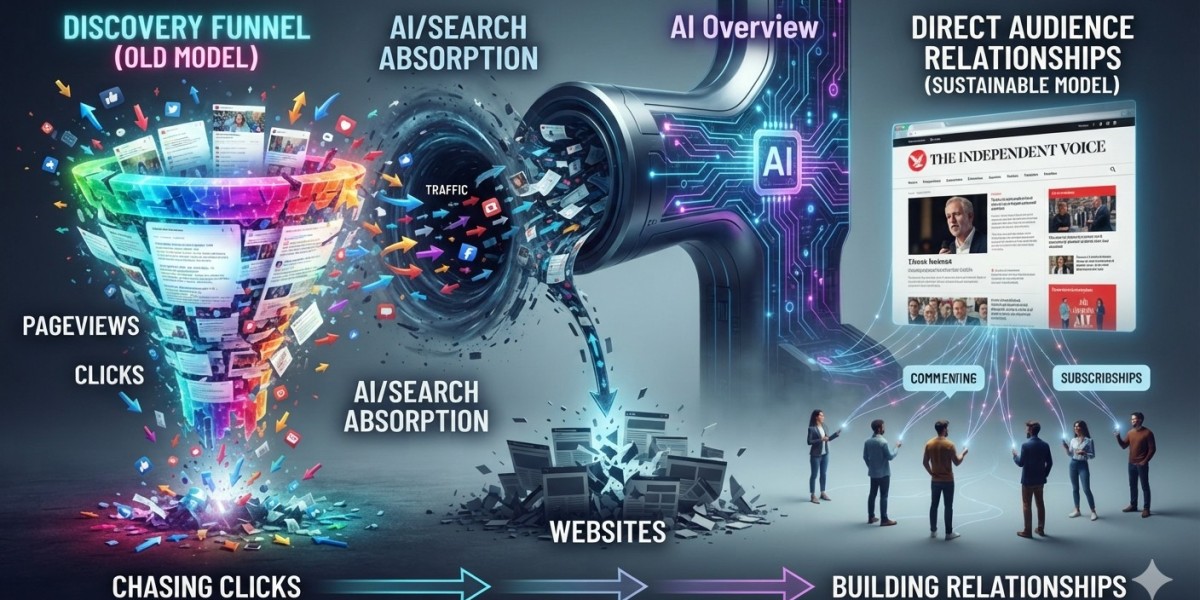
The internet does not feel broken so much as **rearranged**: less like an open bazaar of curiosity, more like a velvet-rope economy where a few giant platforms, answer engines, and search intermediaries collect the foot traffic while everyone else waits outside. What used to be a relatively broad funnel of discovery has narrowed into a system that rewards scale, brand, and machine readability over originality, independence, or even usefulness.
There was a time when the web felt promiscuous in the best sense of the word. You could begin with a recipe, drift into a forum, detour through a tiny site built by an obsessive enthusiast, and emerge hours later having learned something accidental and wonderful. The internet was never innocent, exactly, but it was spacious. It had side streets, cul-de-sacs, weird little storefronts with hand-painted signs.
That feeling is harder to find now. The modern internet is still enormous, but discovery has become strangely provincial. Search engines increasingly answer the question before the click. Social platforms increasingly keep the user inside the app. And AI tools increasingly act as the concierge, the editor, and, in some cases, the destination itself. The result is that many websites now compete not just with each other, but with the layer above them: the interface that decides whether they are even worth visiting.
This is the central tragedy of contemporary publishing: the old bargain was that if you made something good enough, people would find it. Today, “good enough” is only the entrance fee. You also need distribution, technical authority, brand recognition, and a fighting chance against systems that are optimized for frictionless answers rather than curious exploration. The funnel has not merely shrunk; it has been rerouted.
The great traffic squeeze
A lot of website owners can feel the shift in their bones before they can prove it in analytics. Traffic is down. Impressions are up, or flat, or weirdly noisy. Clicks don’t behave like clicks used to. And for many sites, especially publishers and informational brands, the losses are not subtle: reports have described drops of 20 to 40 percent, much of it tied to organic search declines and zero-click behavior.
The term “zero click” sounds clinical, but the experience is emotional. A user asks a question, gets a neat answer at the top of the page, and never comes down to your blue link. In the old web, the click was the point of entry. In the new one, it can feel like an afterthought. AI Overviews and similar answer layers are especially disruptive for informational queries — the kind of queries that once powered blogs, how-to sites, comparison posts, and niche publishers.
That does not mean every form of traffic is collapsing equally. Commercial intent remains more resilient. People still click when they need to compare, verify, buy, book, or evaluate. But the upper funnel — the easy, explanatory, “what is this” layer — is where the bleed is most severe. In other words, the web is not disappearing; it is being edited.
Why giant sites win
One reason traffic funnels toward mega-sites is simple scale. Big companies can fund content, engineering, SEO, paid acquisition, social distribution, email lists, app ecosystems, and brand memory all at once. When search gets harder, they can buy visibility. When organic reach dips, they can lean on direct traffic, newsletters, influencers, partnerships, and loyal audiences. Small sites usually have one or two of those levers, not six.r algorithms to trust. They are heavily linked, frequently cited, technically polished, and often updated at a pace no solo operator can match. That makes them attractive to search engines and answer engines alike. Niche sites may be deeply authoritative, but they are often less legible to machines, less consistently updated, and less heavily reinforced by the broader web.
This is where the romance of the small web collides with the economics of modern discovery. A tiny site can still be brilliant. It can still be loved. It can still matter. But in the attention marketplace, brilliance is not the same as reach. That gap has widened.
Is AI the villain?
AI is not the only cause, but it is a major accelerant. The internet had already been moving toward “answer first, click later” through featured snippets, knowledge panels, people-also-ask boxes, and app-based consumption. AI simply took that tendency and made it more fluent, more pervasive, and more convincing. It’s not that AI invented the decline in clicks; it industrialized the substitution of answers for visits.
Still, it would be too easy to blame AI alone. The broader problem is that the web has spent years optimizing for efficiency over exploration. Search engines reduced uncertainty. Social platforms reduced serendipity. Recommendation systems reduced the need to wander. AI is the latest and most powerful version of that same promise: why browse, if I can summarize? Why click, if I can synthesize? Why read ten sites when one machine can compress them into a paragraph?
The consequence is not just less traffic. It is less *accident*. The old web often worked because it was inefficient. You had to wander, and wandering was the point. The modern web increasingly treats wandering as waste.
Can small sites survive?
Yes — but not by pretending it is still 2012. The sites that survive this era will not necessarily be the ones with the most pages. They will be the ones with the clearest identity, the deepest trust, and the strongest direct relationships with their audiences. Search can still matter, but it cannot be the only engine.
The practical path is to become harder to replace. That means original reporting, first-party data, strong point of view, specialized expertise, and formats AI cannot trivially summarize: tools, calculators, community, video, newsletters, interactive content, case studies, live updates, and real-world experience. It also means writing in ways that are easy for machines to interpret without letting machines own the whole experience.
A small site should aim to be cited, not merely crawled. It should also aim to be remembered. If a reader only finds you once through search, you are vulnerable. If they subscribe, bookmark, return, or recognize your name, you have something sturdier than an algorithmic favor.
What to do now
The first move is to stop measuring success only by pageviews. That metric can flatter the wrong thing and punish the right thing. Engagement, repeat visits, conversion rate, newsletter signups, direct traffic, branded search, and assisted conversions matter more in a world where raw clicks are less reliable.
The second move is to publish for both humans and machines. Use clear structure, explicit headings, concise summaries, schema where appropriate, and evidence that signals authority. In the AI era, machine readability is not a gimmick; it is table stakes. If your work cannot be understood, quoted, and attributed cleanly, it will struggle to surface at all.
The third move is to diversify distribution. A site that depends on one channel is living on borrowed time. Email, social, partnerships, communities, podcasts, video, and direct audience ownership all matter because they reduce dependence on search alone. The winners of the next phase of the web will be the ones who build an audience, not just attract visits.
Ahead of the curve
The deepest shift may be psychological. For twenty years, web operators were trained to chase volume. More traffic meant success. More impressions meant relevance. More ranking keywords meant safety. That logic is breaking down. A smaller number of highly qualified visitors may now be worth more than a flood of indifferent ones.
So the real question is not whether the old internet is dying. It is. The question is what replaces it. My guess is a more closed, more mediated, more branded, more AI-shaped web — one in which the most valuable properties are not the loudest, but the most useful, the most trusted, and the most structurally difficult to imitate. The web will still have room for the strange and the independent, but those spaces will need sharper strategy and more deliberate audience-building than before.
In that sense, the answer is not nostalgia. It is adaptation. If the funnel is narrowing, then the challenge is to stop thinking like a site and start thinking like a relationship. The websites that endure will not merely be discovered. They will be sought out.
If you want, I can turn this into a more polished Vanity Fair-style feature with a sharper lede, a more dramatic ending, and a stronger magazine voice — or adapt it into a Substack-style essay, SEO article, or LinkedIn op-ed.