.png)

The Day the Keyword Kings Lost the Map
For years, the people who called themselves SEOs lived with the tranquil confidence of hedge-fund managers who had somehow obtained tomorrow’s newspaper.
They had charts. They had dashboards. They had private Slack channels where they dissected a Google update the way court astrologers once interpreted a blood-red moon. They spoke in an alphabet soup of their own invention—CTR, E-E-A-T, DA, DR, SERP—and built handsome careers around a flattering proposition: that the internet was chaotic, yes, but not unknowable. Beneath its billions of pages, its gossip, its recipes, its product reviews, its earnest how-to guides on removing coffee stains and changing air filters, there was an order. Google had a machine. The machine had preferences. And if you learned those preferences—if you fed it sufficiently optimized copy, tidy internal links, a few authoritative backlinks, appropriately placed headers, and perhaps a thousand words on “the best adjustable standing desks for remote workers”—the machine would reward you.
Traffic would come.
Not all at once, and not without the occasional tantrum from Mountain View. But it would come. A site would rise. A client would rejoice. A founder, who had not thought about a keyword in his life, would suddenly become very interested in “content velocity.” Somewhere, an agency strategist would place a triumphant screenshot from Ahrefs into a PowerPoint deck and call it growth.
The arrangement had the comforting permanence of a country club. Google got its endless library. Publishers got visitors. Brands got leads. SEO professionals got to behave as if they were bilingual diplomats in negotiations between human curiosity and an inscrutable god.
Then artificial intelligence arrived, wearing no lanyard, no conference badge, no interest in anyone’s quarterly content calendar.
And suddenly, the people who had Google dialed in are staring at the phone as if it has stopped ringing.
The most unsettling thing about this new era is not that rankings have become volatile. Rankings have always been volatile. Google has spent two decades training an entire industry to accept the emotional weather of algorithm updates: a little panic in the spring, a little bloodletting in the fall, then a webinar about “helpful content” to put everybody back to sleep.
No, this is different. The unnerving change is that the old prize—being clicked—has begun to lose its assumed connection to being found.
A searcher asks a question. An AI summary answers it. A chatbot synthesizes the research. A search engine becomes a concierge, then a columnist, then, on a bad day, a perfectly competent intern who has already read the stack of articles you hoped someone would visit. The user gets what they came for without ever taking the exit ramp onto your website.
For the SEO class, raised on the holy metric of organic sessions, this is an existentially rude development.
The blue link was not merely a feature. It was the economic engine beneath an enormous portion of the internet. It was the small, glittering doorway through which publishers ushered in audiences, advertisers, affiliate commissions, newsletter subscribers, buyers, and occasionally people who would spend six baffling minutes reading 3,000 words about whether dogs can eat strawberries.
Now the doorway is still there, technically. It is simply farther down the hall.
The Old Religion
There was a period—not so long ago, though it now feels like the age of lacquered fax machines—when SEO had the clean glamour of a cheat code.
If you were clever, diligent, or morally flexible enough, you could identify a question people were asking, build a page tailored precisely to that question, and wait for the traffic to pour in. The formulas changed over time. First it was keywords, then backlinks, then content depth, then topical authority, then author bios, schema markup, Core Web Vitals, and the endlessly expanded doctrine of experience, expertise, authoritativeness, and trust.
The worship evolved, but the religion stayed remarkably stable: Google would send people to websites.
Even the most sophisticated SEO campaigns relied on that essential bargain. You could optimize titles until they sang. You could commission skyscraper content, with every heading engineered to catch a query drifting through the ether. You could hire experts, publish original research, improve your site speed, repair broken links, refresh aging posts, win digital PR placements, and construct internal linking architectures that resembled the transit maps of a small European capital.
But all of it depended on a consumer behavior so ordinary that it was barely examined: people searched, saw links, and clicked them.
Artificial intelligence has made that behavior optional.
It is not that people have stopped wanting answers. They may want them more urgently than ever. The difference is that they increasingly want an answer without the ritual. No list of ten links. No tabs multiplying like rabbits. No introductory paragraph explaining why “in today’s fast-paced digital landscape” the subject at hand is more important than ever. Just tell me whether I need a visa. Just tell me which software integrates with the thing I already use. Just tell me why my tomato leaves are turning yellow.
The old web was built around the journey to the answer. The new one is increasingly optimized to erase the journey.
For traditional publishers, especially those whose businesses depended on informational searches, that distinction is the sound of glass breaking.
Google’s own users have been reporting traffic declines associated with AI-generated answers, while marketers increasingly describe the new environment as one in which visibility does not reliably become visits. One recent Semrush study projected that AI-search referrals could eventually overtake traditional organic search traffic, while also finding that AI-referred visitors may convert at a higher rate—an encouraging statistic that arrives with the emotional warmth of being told your smaller apartment has better light. [support.google](https://support.google.com/webmasters/thread/372422861/facing-traffic-decline-due-to-google-s-ai-overviews-%E2%80%94-seeking-advice?hl=en)
The Great Unclicking
There is a particularly cruel irony in watching SEO professionals confront the rise of AI search: many of them helped build the conditions for it.
For years, the industry pursued efficiency with almost religious devotion. Find the question. Reverse-engineer the intent. Deliver the answer. Remove friction. Make content scannable. Add FAQs. Write concise definitions. Break everything into bite-size chunks a machine can understand, parse, index, rank, and distribute.
Then the machine learned to do exactly that.
It learned to scrape the consensus, summarize the answer, compare the options, state the caveat, and present the result in a neat conversational bundle. The web spent years turning itself into structured data and comprehensible fragments. AI came along and discovered that those fragments could be assembled into an answer without the troublesome necessity of sending anyone to the original party.
There is a word for this phenomenon in SEO circles: zero-click search. It has the sound of a term invented at an airport bar after an industry conference, but it accurately captures the bleakness of the moment. Search happens. Intent is satisfied. Nobody clicks.
The publisher is cited, perhaps. The brand is mentioned, maybe. The content team sees an impression in Search Console and wonders whether it should feel grateful. Somewhere, a director of growth is trying to explain to a board that appearing in an AI answer is a form of success even though the traffic line looks like it has fallen down a staircase.
This is not to say the click is dead. E-commerce queries still invite shopping. Local searches still compel action. Complex research, high-stakes decisions, specialized expertise, original reporting, and anything requiring judgment beyond a quick synthesis can still push people toward actual destinations. Nobody sensible wants an AI summary to replace their lawyer, surgeon, contractor, wedding photographer, or divorce accountant.
But the most easily commoditized informational traffic—the traffic that once made editorial calendars feel like oil fields—is in trouble.
The once-reliable “What is?” article. The 10-step explainer. The comparison page assembled from publicly available specifications. The listicle engineered around a question with a simple answer. These have become the digital equivalent of taxi medallions on the day ride-sharing arrived: still real assets, perhaps, but suddenly haunted by a new logic of transportation.
A Crisis of Confidence
The traditional SEO expert was always part analyst, part priest, part casino whisperer. Clients wanted certainty, but certainty was not actually available. What was available was interpretation: a blend of data, inference, superstition, technical competence, and the reassuring confidence of someone who knew the difference between canonical tags and canonical nonsense.
AI has made the confidence problem more difficult.
The old model offered a reasonably legible chain of events. Improve content. Earn authority. Rank higher. Gain traffic. Convert traffic. Report success.
Now that chain has been interrupted by an entity that might quote your site, summarize your site, reframe your site, misunderstand your site, cite your competitor instead, or simply answer the question so well that no site is needed at all.
This has created a subtle but profound humiliation for an industry built on prediction. The SEO who once arrived at the meeting with a polished roadmap now has to say something closer to: “We need to increase our odds of being selected by systems whose selection criteria are not fully public, whose interfaces change frequently, and whose rewards may not show up in our web analytics.”
It is not a pitch designed to make a chief financial officer throw confetti.
Worse, AI has destabilized the production side of the business. For years, agencies sold research, briefs, outlines, metadata, audits, content, reporting, and strategy as separate layers of expertise. Now any founder with an AI subscription can generate an article outline before breakfast and a keyword cluster by lunch. This does not mean the founder has generated anything good, useful, accurate, original, or commercially intelligent. But it does mean that the old aura around routine SEO labor has weakened.
A great SEO is not obsolete. A great SEO is becoming harder to distinguish from the person who used to call themselves a great SEO because they knew how to export a spreadsheet.
That distinction matters.
The people who will survive this transition are unlikely to be those who promise to “beat the algorithm.” That sentence now has the faintly embarrassing ring of someone announcing they have figured out how to win at roulette. The durable practitioners will be the ones who understand businesses, audiences, distribution, technical systems, editorial quality, brand trust, and conversion—not merely rankings.
In other words, SEO may have to become marketing again.
The New Status Game
For years, traffic was a status symbol. It was countable, chartable, easy to admire. Ten thousand monthly visits. One hundred thousand. A million. Founders posted growth screenshots with the same casual triumph once reserved for vacation photos from Mykonos.
But traffic is becoming a stranger kind of currency.
An AI-referred visitor may be more intentional. Someone who has moved from a broad question inside a chatbot to a specific website may arrive closer to a decision, more informed and less likely to bounce. Yet the total volume of those visitors may be dramatically smaller than the old search firehose. The new contest is less about catching every passerby and more about becoming the destination people—or machines—trust when the question gets serious.
That favors brands with something to say beyond the obvious.
Original data. Firsthand expertise. Exclusive interviews. Strong products. Deep communities. Tools people can use. A recognizable point of view. Reporting that cannot be summarized without losing what makes it valuable. Content that is not merely an answer, but an experience, an argument, a utility, a relationship.
The web may be moving toward a harsher divide. Generic content becomes raw material for AI systems. Distinctive content becomes a reason to leave them.
It is a difference that every publisher, brand, and agency will have to learn to recognize. A page designed to answer a basic question is easy to replace with a basic answer. A page that provides lived expertise, a useful calculator, an original database, a compelling voice, a proprietary framework, or an inconveniently human insight is harder to compress into a paragraph.
The SEO playbook is not gone. It has simply lost its monopoly on the future.
Technical health still matters. Search demand still matters. Authority still matters. Intent still matters. Google itself has not disappeared into a mist of chat bubbles. But “rank, click, convert” no longer describes the whole game. Brands now have to think about being discoverable across search engines, AI assistants, social platforms, communities, newsletters, video, podcasts, marketplaces, and the weirdly resurgent power of someone telling a friend, “You should check this out.”
The old SEO economy was a landlord’s economy. Own the right page in the right neighborhood, and Google would send pedestrians past your door.
The emerging economy is less comfortable. You have to give people a reason to come inside.
After the Panic
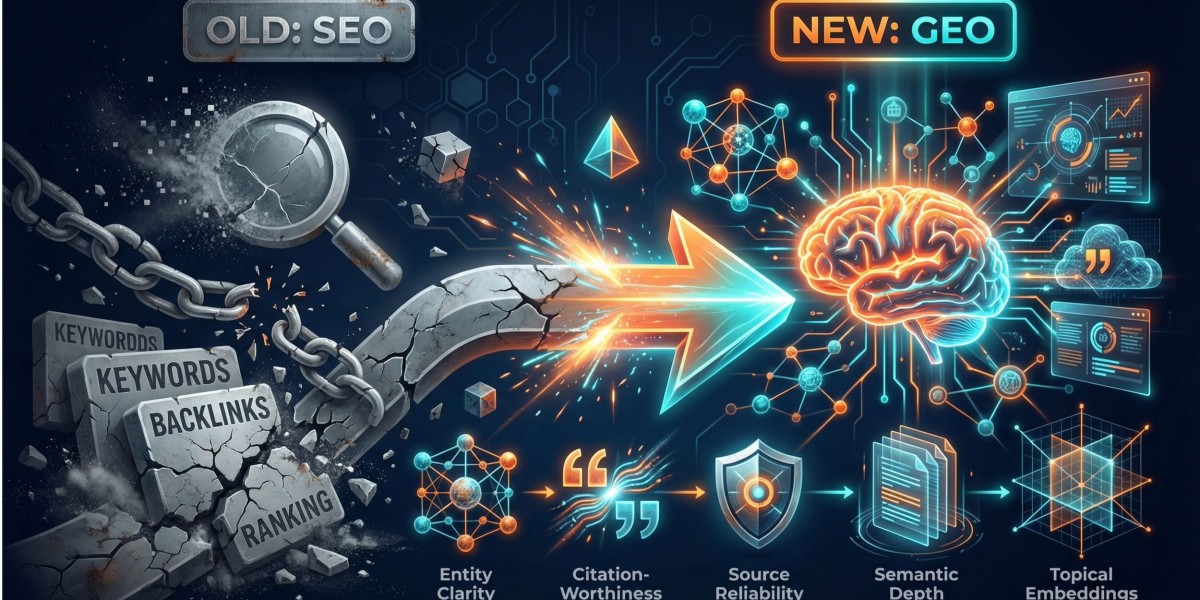
There will be mourning, naturally. There will be LinkedIn posts written in the tone of war correspondents. There will be agencies renaming themselves “AI visibility partners” and charging an additional 40 percent for what used to be called content strategy. There will be case studies with mysterious charts, new acronyms, executive webinars, and breathless promises that somebody has finally cracked generative-engine optimization.
They have not. Not entirely.
Nobody has Google dialed in now, and anybody who claims otherwise is probably selling a course, a dashboard, or an invitation to a private Discord.
But this may not be the disaster that the more melodramatic corners of the industry imagine. It is, instead, an overdue correction to a strange digital economy in which too much content existed primarily to intercept a question on its way to somewhere else.
The winners of the AI era will not be those who most efficiently produce disposable pages. They will be those who create value that cannot be reduced to a disposable answer.
That is bad news for the SEO assembly line. It is good news for writers, reporters, experts, designers, product builders, and brands brave enough to have a personality. It is good news for anyone who remembers that the internet was once supposed to be more than an enormous waiting room for Google traffic.
Still, one should spare a thought for the old keyword kings. They had their maps. They had their dashboards. They had their confident forecasts, their painstakingly optimized headlines, their immaculate spreadsheets glowing under the fluorescent lights of the content-industrial complex.
For a while, they really did have Google figured out.
Or at least they had figured out a version of Google that no longer exists.