.png)
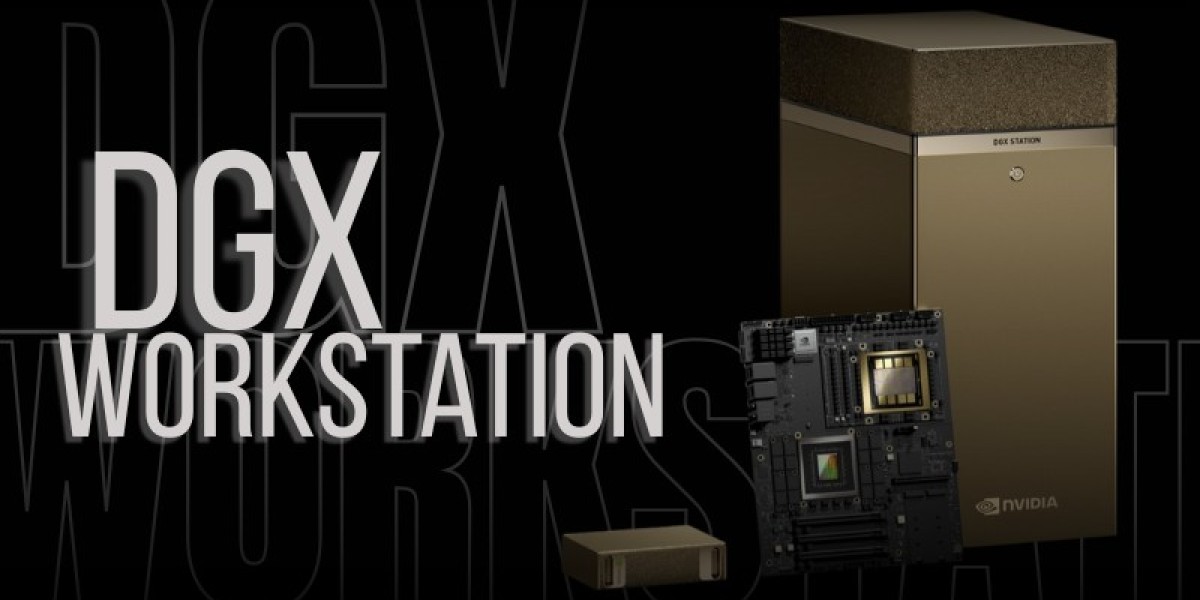

The $100,000 Brain on Your Desk: A Love Letter to Nvidia’s DGX Station
There is a particular kind of thrill reserved for the moment when something once reserved for governments and moonshots quietly appears on a desk. Not metaphorically—literally. It hums. It glows. It consumes power with the confidence of a small appliance and delivers computational force once measured in national ambition. The Nvidia DGX Station is one of those objects: a machine so unapologetically powerful that its existence feels like a wink from the future.
It is also, depending on configuration and timing, roughly the price of a luxury sedan. Or, if you prefer your metaphors grounded in lifestyle aspirations, a modest down payment on a house in certain zip codes. This is not an incidental detail. The DGX Station does not arrive quietly. It announces itself in both capability and cost, a duality that makes it as fascinating as it is formidable.
But let us begin with the obvious question: what exactly does one do with a box that can train artificial intelligence models at a pace that would make a traditional workstation weep?
The short answer is: almost anything ambitious.
The longer answer is where things get interesting.
Picture a filmmaker in a converted loft, staring at hours of raw footage. In the past, this was a slow dance with editing software, proxies, and patience. With a DGX Station humming nearby, that same filmmaker can deploy AI models that analyze scenes, identify emotional beats, generate rough cuts, even simulate alternative lighting or camera angles. The machine does not replace creativity—it accelerates it, compressing weeks into hours and turning iteration into instinct.
Or consider a small biotech startup operating out of a nondescript office park. Once upon a time, serious drug discovery required access to massive institutional clusters. Now, with a DGX Station, researchers can train protein-folding models, simulate molecular interactions, and explore hypotheses at a scale previously reserved for pharmaceutical giants. The barrier between “interesting idea” and “testable model” shrinks dramatically.
And then there are the more playful uses, which are perhaps the most telling. Enthusiasts train models to generate hyper-realistic images, to compose music, to write screenplays that toe the line between brilliance and absurdity. Entire fictional worlds can be spun up overnight. Video game developers can generate environments, textures, and behaviors with uncanny speed. The DGX Station becomes less a tool and more a collaborator—one that never sleeps, never complains, and occasionally produces something so strange it borders on art.
Of course, none of this comes without a certain theatricality. The DGX Station is not a discreet object. Its design—sleek, angular, unmistakably Nvidia—signals intent. This is not a beige box tucked under a desk. It is a statement piece, the computational equivalent of a grand piano in a living room. Visitors notice it. Conversations orbit it. It invites questions like, “What exactly does that do?” and, inevitably, “How much did it cost?”
Ah yes, the cost.
Depending on the generation and configuration, a DGX Station can range from tens of thousands to well over $100,000. It is the kind of purchase that requires justification, or at least a compelling narrative. For enterprises, the math is straightforward: time saved, capability gained, competitive edge secured. For individuals, it is more nuanced. It sits somewhere between investment, indulgence, and declaration of intent.
To own a DGX Station is to say, in effect, “I take computation seriously.”
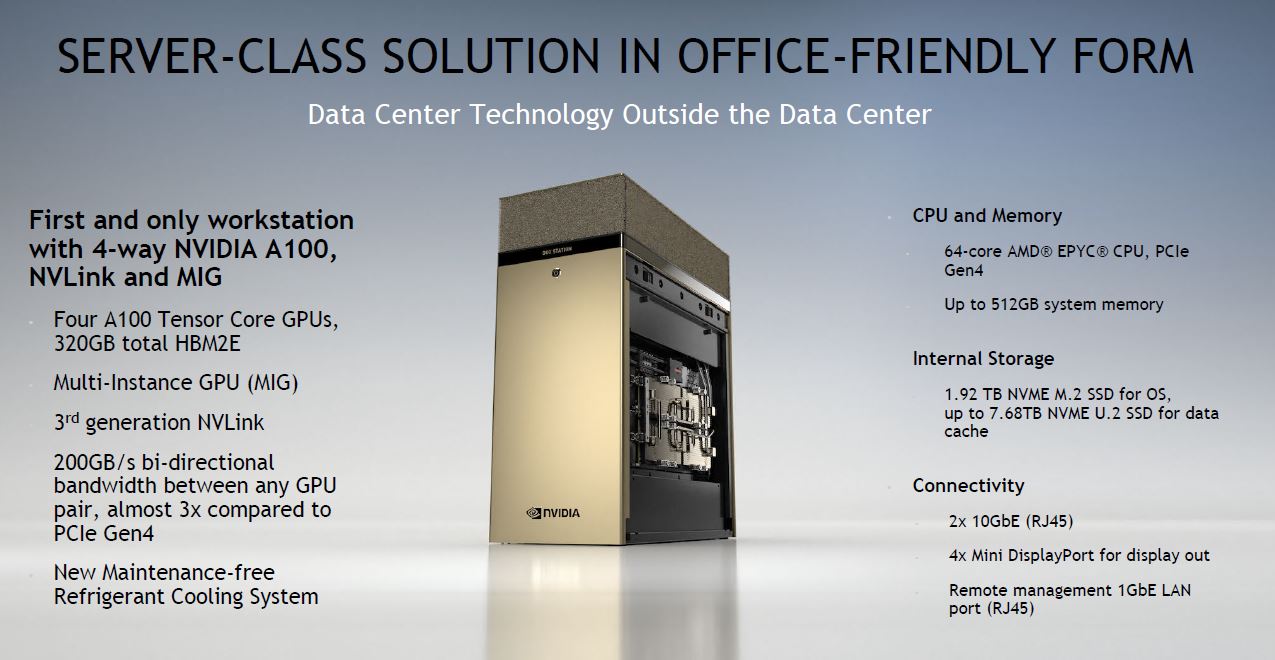
And yet, the price tag is part of the charm. In an era where cloud computing promises infinite scalability at the swipe of a credit card, the idea of buying a monolithic, self-contained AI powerhouse feels almost rebellious. It is a return to physicality, to ownership, to the satisfying certainty that the machine is yours—fully, completely, and without metered billing.
There is also something deeply reassuring about locality. No waiting for remote instances to spin up. No concern about data leaving your environment. No unpredictable costs creeping up at the end of the month. The DGX Station sits there, patient and ready, a silent partner in every experiment.
Of course, it is not without its quirks. It demands power—literal electrical power, the kind that prompts a brief glance at your circuit breakers. It generates heat, a reminder that all this intelligence is, at its core, physics. It requires a certain level of expertise to truly harness, though this is perhaps less a barrier and more an invitation. For the technically inclined, it is a playground. For the curious, it is a challenge.
And for the rest of us, it is a glimpse into a world where the extraordinary becomes routine.
There is a broader cultural shift at play here, one that the DGX Station embodies with quiet confidence. Artificial intelligence is no longer an abstract concept discussed in research papers and keynote presentations. It is a tool—powerful, accessible, and increasingly personal. The democratization of AI is not just about software; it is about hardware, about bringing the capability closer to the individual.
The DGX Station is, in many ways, a bridge between eras. It carries the legacy of massive data centers and distills it into something that can sit beside a desk chair. It transforms the idea of “running a model” from a remote operation into a tactile experience. You can hear it. You can feel it. You can, if you are so inclined, rest your hand on its surface and contemplate the sheer volume of calculations happening beneath.
And then there is the question of possibility, which is perhaps the most compelling aspect of all.
What happens when the tools of advanced AI are no longer gatekept by scale?
We begin to see a proliferation of ideas that would have previously been impractical. Independent researchers tackle problems once reserved for institutions. Small teams compete with large organizations. Individuals experiment, iterate, and create at a pace that feels almost cinematic.
The DGX Station does not guarantee brilliance, of course. It does not replace insight or imagination. But it lowers the friction between thought and execution, and in doing so, it expands the space in which creativity can operate.
There is also a certain humor in the juxtaposition. Here is a machine capable of training complex neural networks, sitting perhaps a few feet away from a coffee mug and a stack of notebooks. It is both extraordinary and oddly mundane, a reminder that the future rarely arrives with fanfare. It slips into our lives, plugs into a wall, and waits for us to decide what to do with it.
For some, the answer will be practical. Faster workflows, better models, more efficient processes. For others, it will be exploratory. What can this do? What can I build? What happens if I push it just a little further?
And for a select few, it will be aspirational. The DGX Station as symbol—a declaration that they are participating in something larger, something transformative.
It is easy, in moments like this, to become overly serious, to frame everything in terms of disruption and paradigm shifts. But there is also room for a lighter perspective. After all, there is something inherently amusing about a machine this powerful being used to generate, say, increasingly elaborate images of cats in Renaissance attire, or to fine-tune a model that writes eerily convincing restaurant reviews.
Power, after all, is only as meaningful as what we choose to do with it.
And so the DGX Station occupies a curious place in the technological landscape. It is at once a tool, a luxury, a statement, and a source of endless possibility. It invites both admiration and skepticism, both excitement and reflection.
Is it necessary? For most people, no.
Is it transformative? In the right hands, absolutely.
Is it a little bit extravagant? Undeniably.
But perhaps that is part of its appeal. In a world increasingly defined by abstraction—by services, subscriptions, and invisible infrastructure—the DGX Station is gloriously concrete. It is a reminder that behind every algorithm, every model, every seemingly magical output, there is hardware—real, tangible, and, in this case, sitting right in front of you.
It hums softly, almost imperceptibly. It waits.
And in that quiet anticipation lies its greatest promise: not what it is, but what it makes possible.
Because ultimately, the DGX Station is not about the machine itself. It is about the ideas it enables, the boundaries it dissolves, and the curious, often delightful ways in which humans choose to use it.
Even if, occasionally, that means spending six figures on a box that can teach a computer to dream.